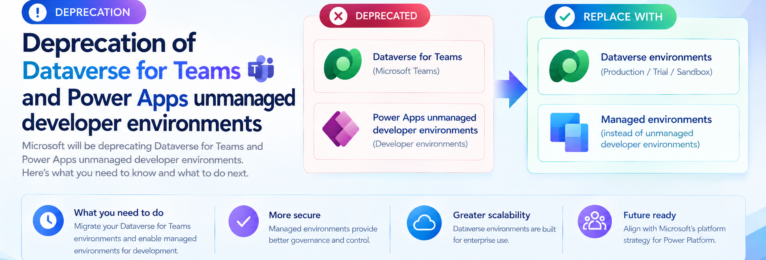
Following up on my previous post of the retirement of vibe.powerapps.com and Copilot App Builder, Microsoft announced two additional deprecations coming up soon. The first is Dataverse for Teams and the second is the unmanaged developer environments and the Power Apps Developer Plan.
Dataverse for Teams
The deprecation of Dataverse for Teams will occur as three separate stages. Starting November 15th, we will not be able to create any new Dataverse for Teams environments. This also includes creating your first app or agent in a team or installing an app from the Teams app catalog. For existing Dataverse for Teams environments, we will have a little more time.
On September 15th of next year any Dataverse for Teams environments that are not upgraded to Dataverse are suspended. The apps, flows, agents and data that are associated with them will no longer be available.
The list stage is the decommissioning of these environments. On October 30th of next year, any Dataverse for Teams environments that have not been upgraded to Dataverse will be decommissioned. The apps, flows, agents and data that are associated with them will be removed.
In Power Platform Admin Center, your admin can identify which are the environments that need to be migrated and perform the migration per the following Microsoft Learn link. The tenant admin will be allowed to upgrade a Dataverse for Teams environment to a Dataverse environment as long as the capacity exists. The high-level flow below shows this process.

Unmanaged Developer Environments and the Power Apps Developer Plan
The deprecation includes the unmanaged developer environments that Power Platform created when a user signs up for the free Power Apps Developer Plan. This deprecation will also occur in 3 separate stages. The first stage, starting November 15th will remove the ability to create new unmanaged developer environments. Existing unmanaged developer environments will be suspended the following month on December 15th, and then will be completely removed on January 15th of 2027.
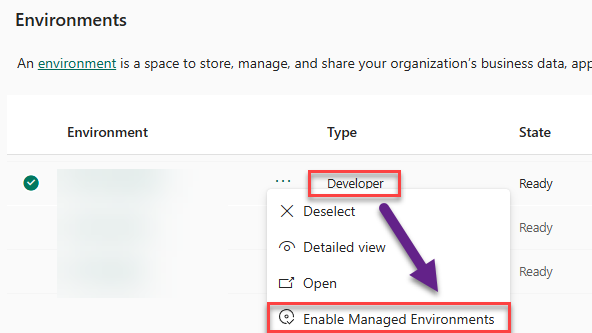
This change does not mean that developer environments will cease to exist, but they will no longer be unmanaged. Developer environments that are managed environments will not be affected by this change. Moving forward end users will be able to create only a single managed developer environment. If users have multiple managed developer environments prior to this change, they will be able to continue to have multiple developer environments as long as they are managed.
Per Microsoft, the reasoning for this change is that unmanaged developer environments do not have the governance that administrators require such as policies, insights and other capabilities. Moving these environments to managed gives the administrators the control that they need over these environments.
If the end users have the appropriate licensing, they will be able to enable the environment as a managed environment